Chapter 02 · 2026 · Enterprise Infrastructure
Consumption pricing for enterprise storage
Four linked models on when paying for storage by usage beats buying hardware up front, from the customer's side and from the vendor's.
- Skills
- Stack
- Python · NumPy · SciPy · Matplotlib · Streamlit · Plotly
Infrastructure vendors are moving from selling hardware up front to charging by usage. I used Storage-as-a-Service (STaaS) as the case: a customer either buys storage arrays or subscribes and pays per terabyte per month.
All inputs are illustrative and drawn from public industry benchmarks. The point is the structure of the reasoning. Change an assumption and the notebooks rerun.
Why
During an internship in commercial risk advisory, I presented the output of Monte Carlo loss models without building them. I wanted to rebuild one from public methodology, then see whether the same tools apply to a different decision: a large up-front purchase under uncertainty against paying as you go.
Approach
Four models, each building on the one before:
- Insurance aggregate loss. Poisson event frequency, lognormal loss size, and a Gaussian copula linking three insurance lines. Outputs the P50, P90 and P99 losses brokers use for premiums, limits and reinsurance.
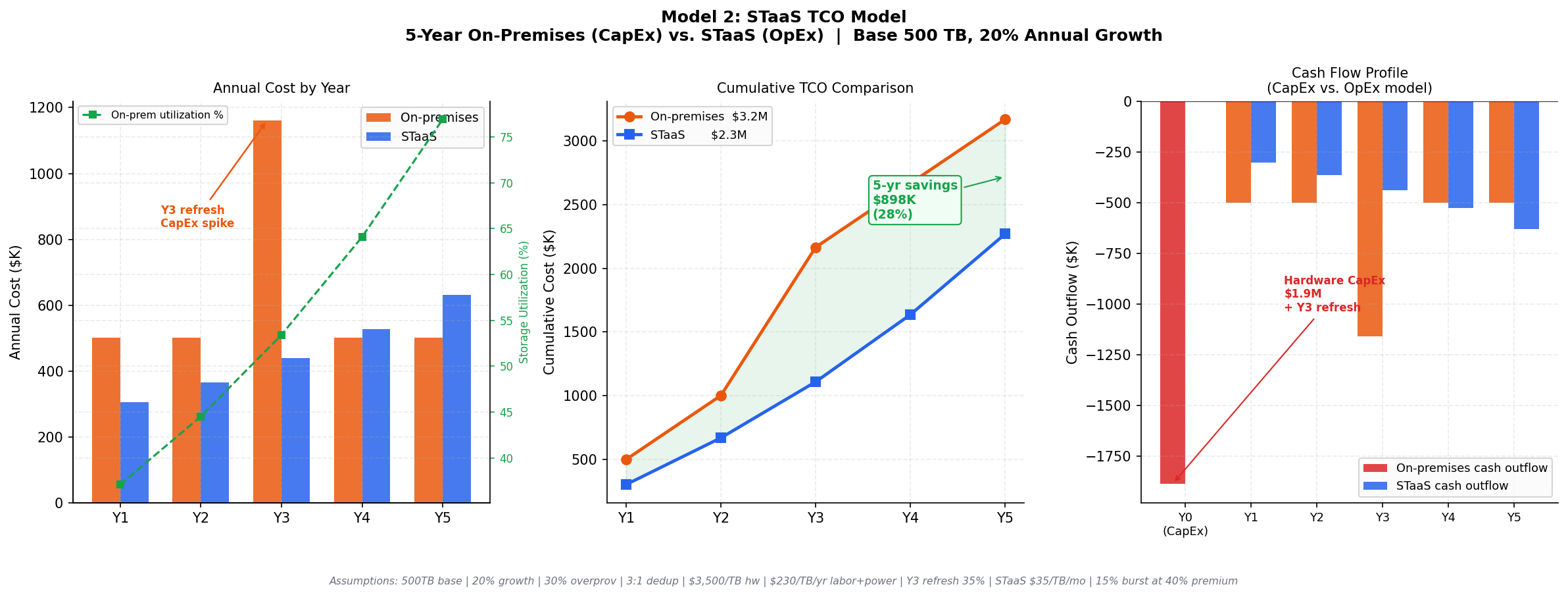
- Five-year cost of ownership. Buying storage against subscribing, with demand growth, overprovisioning, data reduction, a hardware refresh and burst pricing.
- Pricing under uncertainty. Model 2 run 20,000 times with uncertain demand growth and price, plus a sensitivity analysis ranking which input moves the savings most.
- Deal profitability. The vendor’s side. Takes a deal (segment, volume, term, competitor) and returns the discount stack, P&L, risk-adjusted NPV, win probability and the approval level the discount requires. It is also available as an interactive calculator.
Result
- Uncertainty in demand growth moves long-term savings about three times more than the negotiated price does. For a customer, forecasting well matters more than negotiating hard.
- Past about 25% total discount, the chance of winning the deal stops rising while margin keeps falling. Approval tiers are what stop discounts from going further.
- A savings range stated with a confidence level (“with 80% confidence, between X and Y over three years”) is easier to defend than a single number.
Limits and next steps
- Real deals often bundle compute, networking and software with storage. The model prices storage alone.
- Churn is a fixed rate per customer type. In practice it responds to price, support and competition.
- The win-probability curve and segment multipliers are assumed, not fitted to deal outcomes. Fitting them to real data is the next step.